Friday, March 23, 2007

New English translation of the Koran supports moderate view of feminists


Hot off the presses from Reuters, as found through the Drudge Report ! Excellent timing to see that this new version of the Koran will be published the same month as Letter to an Atheist.

NEW YORK (Reuters)
- A new English-language interpretation of the Muslim Holy book the Koran challenges the use of words that feminists say have been used to justify the abuse of Islamic women.

The new version, translated by an Iranian-American, will be published in April and comes after Muslim feminists from around the world gathered in New York last November and vowed to create the first women's council to interpret the Koran and make the religion more friendly toward women.

In the new book, Dr. Laleh Bakhtiar, a former lecturer on Islam at the University of Chicago, challenges the translation of the Arab word "idrib," traditionally translated as "beat," which feminists say has been used to justify abuse of women.


"Why choose to interpret the word as 'to beat' when it can also mean 'to go away'," she writes in the introduction to the new book.

The passage is generally translated: "And as for those women whose illwill you have reason to fear, admonish them; then leave them alone in bed; then beat them; and if thereupon they pay you heed, do not seek to harm them. Behold, God is indeed most high, great!"

Instead, Bakhtiar suggests "Husbands at that point should submit to God, let God handle it -- go away from them and let God work His Will instead of a human being inflicting pain and suffering on another human being in the Name of God."

Thursday, March 22, 2007

Encouraging comments

We're on target for an April 13, 2007 publication date for Letter to an Atheist.

The folks at Lightning Source (the local "Publisher on Demand") have been very helpful, and we're putting the finishing touches on the proofing, editing, and book design. Looks like it will all be uploaded by April 1, which will get the first 50 to us by Friday the 13th (lucky day, yes ?). The joint book signing with Christine Schaub at Landmark Booksellers on Main Street in Franklin, Tennessee will be on April 15th at 3 PM.

Initial feedback from readers for book jacket blurb have been very positive.

Bonnie Calhoun of the Christian Fiction Blog Alliance encouragingly suggests "this could be big !" and counsels finding an agent and a more established publisher. If the first edition from Harpeth River Press does well, we may get an agent and a new publisher for the second edition.

A best selling novelist has read most of it, and likes it.... As the topic is a bit controversial, we probably want be seeing a blurb from this novelist, but the vibe is excellent.

Awaiting word from several academics and theologians.

You should be able to buy Letter to an Atheist at Amazon.com around May 1.

The key focus now is to generate a crowd for the April 15 book signing. We'll be sending out about 300 postcard invitations around April 1. If you want to get on the list, drop us a note here in the comments section and we will add you to our database.

A corresponding article -- Ten Factual Errors and Misrepresenations in Letter to a Christian Nation Sam Harris Will Never Acknoweldge or Refute -- will also be sent to major publications around April 1. Turns out there are more than two dozen of these errors, but in the interest of brevity I pared the article down to the top ten !

The total page count (including appendices) has jumped up to 176, so we've decided to increase the price point from $12.95 to $14.95. I don't think the extra $2 will be the deciding factor on how well the book sells. That will hinge on publicity and marketing, I think.

Thanks to all the friends and supporters who have been so encouraging throughout this process. Apologies if I have not been as quick to respond as usual. This finishing a book thing -- well, it's not like giving birth exactly, but there are some similarities in the processes. Focused, intense, painful, and ultimately (we hope) rewarding !

Tuesday, March 20, 2007

Oh Happy Day !

The first draft of Letter to an Atheist is done and out for review !

What a relief.

Though the schedule for editing and printing is still fairly tight, it looks like we will make our publication date of April 15 with a few days to spare !

It's 117 pages of text (26 more than Letter to a Christian Nation), with another 33 pages of appendices. While it could always be better, I feel fairly comfortable saying that with some additional editing, it should be a pretty interesting little read by April 15 !

Monday, March 19, 2007

Lewis asked What Went Wrong ?


In his 2002 masterpiece of the same name, Middle Eastern scholar Bernard Lewis (1916 - present) asked the question What Went Wrong ?

By that he meant why did the Muslim world, which dominated military, economic, scientific, and technological affairs during the Golden Age of Islam (750-1250 A.D.) find itself behind other major civilizations in all these areas in the subsequent seven and a half centuries ?

Lewis argues that Muslims have been preoccupied with answering the question -- Who did this to us ? They have, he says, offered a series of outside groups to blame for the overall decline -- from the Mongol hordes, to imperialistic Europeans, to Jews, to Americans.

Lewis rejects this explanation, as well as explanations that offer the dramatic rise of the West while Islam failed to advance at the same pace.

He also rejects the argument that the decline is inherent to the Islamic faith.

The medieval Islamic world offered only limited freedom in comparison with modern ideals and even with modern practice in the more advanced democracies, but if offered vastly more freedom than any of its predecessors, its contemporaries, and most of its successors.

What caused the decline then ?

Some indeed have posed the question in a different form -- not "What has Islam done to the Muslims?" but " What have the Muslims done to Islam ?, " and have answered by laying the blame on specific teachers and doctrines and groups.

For those nowadays known as [Islamic fundamentalists] the failures and shortcomings of the modern Islamic lands afflicted them because they adopted alien notions and practices. They fell away from authentic Islam, and thus lost their former greatness.

Those known as modernists or reformers take the opposite view, and see the cause of this loss not in the abandonment but retention of old ways, and especially in the inflexibility and ubiquity of the Islamic clergy...


A more usual approach to this theme is to discuss not religion in general, but a specific problem: the place of religion and its professional exponents in the political order. For these, a principal cause of Western progress is the separation of church and state and the creation of a civil society governed by secular laws...

To a Western observer, schooled in the theory and practice of Western freedom, it is precisely the lack of freedom--freedom of the mind from constraint and indoctrination, to question and inquire and speak; freedom of the economy from corrupt and pervasive mismanagement; freedom of women from male oppression; freedom of citizens from tyranny--that underlies so many of the troubles of the Muslim world.

Monday, March 12, 2007

The Controversial Professor Leuba

James H. Leuba (1867-1946) was a native of Switzerland who emigrated to the United States. From 1898 until 1933 he was a Professor of Psychology at Bryn Mawr College in Pennsylvania.

An admirer of William James, he became one of the founders of the academic study of the psychology of religion. An atheist, he believed that religious phenomenon could be studied as physiological events, and spent a great deal of time making a connection between drug use and religious mysticism.

He generally attempted to show in his research that the more educated a person was, the less they were inclined to believe in God.

Leuba figures prominently in two major controversies, both resulting from his famous 1916 study The Belief in God and Immortality.

One conclusion of this work was that college students were less likely to believe in God after leaving college than upon beginning college. William Jennings Bryant apparently read this study, and became so incensed by the "indoctrination" students were receiving from atheist professors he began looking for an opportunity to defend the faith in an educational setting. He was prepared, therefore, when he was called to prosecute the Scopes "monkey trial" in 1925 held in Dayton, Tennessee.

Of more immediate relevance to my book, Letter to an Atheist, is Leuba's survey of American scientists. Using the 5,500 names in the publication American Men of Science (apparently Leuba could not find any American Women of Science in 1914 when the survey was conducted), Leuba sent surveys to 1,000 randomly selected members. He received 750 responses. The results showed that 41.8% of the responding scientists believed in God. Such a response rate suggests a 95% confidence level that the results are correct, plus or minus 4 per cent.

Leuba tried to break down these results even further, separating the scientists into two different groupings: (1) physical scientists and biological scientists and (2) greater and lesser scientists by subjective estimates of the quality of their work.

Leuba claimed that biological scientists showed less belief in God than physical scientists.

He also claimed that "Greater" scientists showed less belief in God than "Lesser" scientists.

A closer look at his methodology suggests that his sample sizes for these different groupings were probably not large enough to make any conclusions with a high degree of confidence.

His sample size for physical scientists was 450, and biological scientists 300.

His sample size for "Lesser" scientists was 450, and "Greater" scientists was 300.

Leuba further complicated his findings by breaking up his study into two divisions of 500 each, each of which received approximately 375 responses. Division 1, for instance, consisted of 375 responses -- 150 from "Greater" Scientists and 225 from "Lesser" scientists. By area of functional expertise, Division 1 broke down approximately as follows: 202 physical scientists, 150 biological scientists, and 23 psychologists, philosophers, and sociologists. Leuba acknowledged that it was an error to include psychologists, philosophers, and sociologists in Division 1, and they were excluded from Division 2. In the same survey, psychologists had significantly lower rates of belief in God, but Leuba did not remove their contaminating influence from the results of Division 1.

The results of his study have been misreported as a consequence.

For instance, Nature Magazine reported in 1998 that Leuba concluded in his 1916 study that only 27% of the "Greater" scientists were believers. This is not accurate.

27% of the respondents to Division 1 reported a belief in God.

35% of the respondents to Division 2 reported a belief in God.

Nature Magazine failed to account for the inherent corruption of the Division 1 sample by psychologists, nor did it address the sample size problem.

The "margin of error" for a sample size of 150 is approximately 9 per cent.

Even if we were to accept the subjective breakdown of "greater" and "lesser" scientists that Leuba performed, the supposed difference between "greater" scientists and the population of scientists as a whole lies within the margin of error, and therefore, cannot be claimed.


One final comment on Leuba.

Though it is of no relevance to this argument, it turns out that he is remembered fondly by one of his students. The actress Katharine Hepburn (Bryn Mawr Class of 1928) recalls Professor Leuba in her memoirs for his kind and avuncular advice to her.

Friday, March 09, 2007

Beaten to the punch on The Dawkins Delusion


Christian theologian Alister McGrath has beaten me to the punch on The Dawkins Delusion. Can't wait to read it !

Yockey on Science and Faith

Science, religion and literature are all legitimate paths to truth. Literature and religion have belief systems which are different, and in a sense opposite from those of science. The truth in literature lies outside the methods of science. The poet says: "the bird of time has but a little way to flutter and the bird is on the wing." The scientist says: "Time is not a bird and the wing is an appendage on the bird, not the other way around."

Scientific beliefs are never absolute. Doubt is a virtue in science and many theories, thought to have been well established, were replaced because tiny discrepancies led to the unraveling of the whole structure of the theory. Faith, on the other hand, plays a central role in religion. The conflict between literature and religion, on one hand, and science on the other, would be resolved if proponents of both realized this difference in belief systems. The new journal, Truth, can play a useful role in establishing a dialogue. We may be surprised how many scientists are really talking religion and how many theologians are talking science.


Hubert P. Yockey 1993

Author of Information Theory and Molecular Biology Cambridge University Press (1992)

Wednesday, March 07, 2007

Thoughts on Stephen Jay Gould

Stephen Jay Gould (1941-2002) was a funny looking fellow, a combination of Fred Flintstone and John Goodman in appearance. The cartoon like image that his droopy moustache, rumpled academic clothing, and sleepy looking eyes created, however, disappeared the moment he opened his mouth. Anyone who listened to him speak more than two consecutive sentences knew immediately -- this guy was a genius.

I first met Professor Gould in the fall of 1973. I was a freshman at Harvard and had signed up for his introductory Geology course, Natural Sciences 10, or, as it was affectionately known "Rocks for Jocks".

Gould was one of the most interesting and engaging professors I ever had. A scientist who studied all sorts of odd sounding, ancient creatures, he was extremely familiar with a broad range of literature. He sprinkled his lectures with numerous references to the Bible, both the Old Testament and New Testament, leading me to conclude that he was fascinated by that book.

Later in life, of course, he would become known as an opponent to the Creationist movement popular within the "Religious Right." His relationship with the Intelligent Design movement was equally uncomfortable. Phillip E. Johnson quoted his reservations about classical Darwinism liberally in his famous book Darwin on Trial, but Gould vigorously protested that Johnson had not gotten his position right.

New York City born and bred, Gould's father was an avowed Marxist, and that philosophy must have had some influence on his son, though he would often deny that it was a political philosophy with which he had much in common.

Working on the Science, Faith, and Atheangelism chapter of Letter to an Atheist, I am thrilled to be revisiting Gould's work. Looking at his work afresh, especially in the context of the atheangelism of many of his fellow evolutionary biologists, I find myself increasingly drawn to Gould's views in a couple areas, especially in his view that science and religion are separate realms of inquiry. In this he differs from his enemy Richard Dawkins, who sees the two realms intertwined. Science, Dawkins might argue, exists to destroy religion.

Gould and Dawkins also disagreed significantly on evolutionary theory. Gould argued that Darwin's gradualism of speciation was not really reflected in the fossil record. Rather, life evolved in a sort of punctuated equilibrium, in which there would be long periods of relative "stasis" among species, followed by sudden and dramatic changes -- many existing species becoming extinct, many new species springing up.

For Dawkins, evolution is completely explained by natural selection. For Gould other developmental factors played a role.

Janet Browne on Huxley


Janet Browne, now a Professor of the History of Science at Harvard, seems to lend some support to my view of Thomas Huxley as the father of atheangelism in her masterful two volume biography of Charles Darwin.


When [Harvard botanist and Darwin's Dove Asa] Gray went to dine at the X Club he found England's other Darwinists were much more men of the world. Warily, he distanced himself from what he called "the English-materialistic-positivistic line of thought," by which he probably meant Huxley . . . Huxley was rampaging on miracles and the existence of the soul. A few months later, he was to coin the word "agnostic" to describe his own position as neither a believer nor a disbeliever, but one who considered himself free to inquire rationally into the basis of knowledge. . .

The term fitted him well . . . and it caught the attention of the other free thinking, rational doubters in Huxley's ambit, and came to signify a particularly active form of scientific rationalism during the final decades of the 19th century...


In his hands, agnosticism became as doctrinaire as anything else--a religion of skepticism. Huxley used it as a creed that would place him on a higher moral plane than even bishops and archbishops. All the evidence would nevertheless suggest that Huxley was sincere in his rejection of the charge of outright atheism against himself.

To inquire rigorously into the spiritual domain, he asserted, was a more elevated undertaking than slavishly to believe or disbelieve. "A deep sense of religion is compatible with the entire absence of theology," he had told [Anglican clergyman] Charles Kingsley back in 1860. "Pope Huxley", the [magazine] Spectator dubbed him. The label stuck.


(Source: Browne, Janet, Charles Darwin, The Power of Place, pages 309-310)


Professor Browne clearly saw Huxley's belief structure as a religion. She does, however, seem to accept Huxley's claim that he was not an atheist, a claim of which I am dubious. Judging by Huxley's rabid anti-clericism, the antipathy he expressed for organized religion, and the complete body of his work on the topic, my view is different. I suspect that Huxley's decision to claim agnosticism's distinction as not being atheistic was really part of his on going public relations battle to gain public acceptance for his views. Certainly his tactics were consistent with my description of atheangelism.

Consider for a moment the conversation between English atheist Edward Aveling and Charles Darwin at Darwin's residence in September, 1881:

Aveling urgently asked Darwin if he was an atheist. He preferred the word "agnostic" he replied. "Agnostic was but Atheist writ respectable," responded Aveling, "and Atheist was only Agnostic writ aggressive."

(Source: Browne, page 484)

What Asa Gray called "the English-materialistic-positivistic line of thought", I call atheangelism when it is combined with the aggressive deliverance of that message to the public in a way that claims moral superiority and ridicules the intellectual integrity of opposing viewpoints.

I spoke with Professor Browne via phone today and asked if she might consider reviewing Letter to an Atheist. She politely declined, citing a heavy academic workload. I described my theory of Huxley as the father of "atheangelism" and Professor Browne had no comment on that term one way or the other.

It would be interesting to see her thoughts on "atheangelism" if she had time to review my chapter on "Science, Faith, and Atheangelism."

Monday, March 05, 2007

Huxley on Abiogenesis

Here are the words of Thomas Huxley, scientist, Darwin's Bulldog, the father of Atheangelism, and coiner of the word "agnosticism" on the concept of abiogenesis -- the creation of life from inanimate matter.

But though I cannot express this conviction of mine too strongly, I must carefully guard myself against the supposition that I intend to suggest that no such thing as Abiogenesis ever has taken place in the past, or ever will take place in the future.

With organic chemistry, molecular physics, and physiology yet in their infancy, and every day making prodigious strides, I think it would be the height of presumption for any man to say that the conditions under which matter assumes the properties we call "vital" may not, some day, be artificially brought together. All I feel justified in affirming is, that I see no reason for believing that the feat has been performed yet. . .

But expectation is permissible where belief is not; and if it were given me to look beyond the abyss of geologically recorded time to the still more remote period when the earth was passing through physical and chemical conditions, which it can no more see again than a man can recall his infancy, I should expect to be a witness of the evolution of living protoplasm from not living matter.

I should expect to see it appear under forms of great simplicity, endowed, like existing fungi, with the power of determining the formation of new protoplasm from such matters as ammonium carbonates, oxalates and tartrates, alkaline and earthy phosphates, and water, without the aid of light. That is the expectation to which analogical reasoning leads me; but I beg you once more to recollect that I have no right to call my opinion anything but an act of philosophical faith.


Thomas Huxley
1870

Deja Vu


As that great philosopher Yogi Berra once said, it's deja vu all over again.

Extinguished theologians lie about the cradle of every science as the strangled snake beside that of Hercules, and history records that whenever science and dogmatism have been fairly opposed, the latter have been forced to retire from the lists, bleeding and crushed, if not annihilated, scotched if not slain.

Thomas Huxley
1860

The success of science often comes at the expense of religious dogma; the maintenance of religious dogma always comes at the expense of science.

Sam Harris
2006

Thursday, March 01, 2007

The rise of Atheangelism

Darwin could not have predicted how effectively his theory would aid the rise of "atheangelism".

For those of you unfamiliar with the term, don't bother looking for it in the dictionary. I've just coined it, and here's how I define it:

An "atheangelist" is a person who aggressively evangelizes the cause of atheism to the general public, using the theories of Charles Darwin to support the argument that there is no God. Common tactics of atheangelists include ridiculing the intelligence of those who hold an alternate point of view as well as ignoring or glossing over the legitimate scientific arguments presented by opponents. Atheangelism is a world view and belief structure based on certain key assumptions, which include abiogenesis, the unassailability of Darwinism, and the natural superiority of atheangelism to all other belief structures.

Thomas Huxley was the first atheangelist, and the belief structure was christened in 1860 during his famous debate with Bishop Samuel Wilbeforce. The atheangelist standard since then has been carried by many scientists and social theorists, including Ludwig Bruchner, Richard Dawkins, and Sam Harris.

More thoughts on Darwin

Charles Darwin has been the central figure in the "faith versus science" controvery for a century and a half. He was very uncomfortable with that role during his lifetime, and, my guess is, he would be even more uncomfortable with that role if he could join us today.

Janet Browne's two volume biography of Darwin paints the picture of an avuncular, modest, private man who followed his scientific thoughts where they lead. A gentleman of leisure due to inherited wealth, Darwin was a devoted family man, well respected member of his small community (Downe), and a good friend to many.

He knew that his theory could lead in a direction of atheism, but welcomed Christian believers and non-believers alike to review and understand the science behind it.

Much has been made of his personal journey of faith -- too much probably. The atheists who found in it the scientific basis to support their beliefs overplayed their hand, in his opinion. And yet, his own personal descent into agnosticism was a fact that men like Thomas Huxley and Ludwig Bruchner did not fail to mention in their quest to destroy faith.

Darwin was much more accepting of the Christian views of others than either Huxley or Bruchner. Indeed, the sense I get from reading of his life is that he was very conflicted on the matter.

Born a Christian, but surrounded by non-believers, Darwin did not abandon his Christian faith until 1851, when his ten year old daughter died. His wife Emma was a strong Christian throughout her life, and one can imagine the tension within the household when aggressive atheists came by to visit the retiring Darwin and his wife played the gracious hostess.

If Darwin were here today, I imagine he might send a gentle note of advice to Richard Dawkins and Sam Harris. The content of the note ? Probably a suggestion to focus on the science of his theory and not to apply it aggressively and publicly to matters of faith.

Tuesday, February 27, 2007

Darwin's views of the American Civil War

Charles Darwin relied upon four close friends as he developed his theory of natural selection. Charles Lyell, Joseph Hooker, and Thomas Huxley in England, and Asa Gray in America were his four stalwarts.

When the Civil War erupted in 1861, Darwin's fervent anti-slavery position brought him to disappointment in Lincoln, and conflict with his American friend Gray. A Lincoln man, Gray drew Darwin's ire for supporting the Union over immediate abolition. He lost all enthusiasm for the North when Lincoln's Emancipation Proclamation freed the slaves in those rebelling states, but not the loyal border states of Maryland, Kentucky, Delaware, and Missouri.

Writing to Gray in 1863, he declared:

Some few, and I am one, even wish to God, though at the loss of millions of lives, that the North would proclaim a crusade against slavery. In the long run, a million horrid deaths would be amply repaid in the cause of humanity...Great God how I should like to see that greatest curse on Earth, slavery, abolished.

Darwin's willingness to sacrifice millions of American lives comes across as quite shocking a century and a half later. The statement reenforces the thought that great scientists may be great in science, but no more qualified to comment on other matters -- theology, or public policy-- than the average Joe.

There are hints here of the kind of totalitarian "greater good" that sacrificed individual rights for some noble concept of the welfare of all. Those kinds of experiments end in the horrific excesses of communism and fascism that we know so well.

And it also brings to mind Sam Harris' recent comments complimenting the fascists in Europe for their approach to dealing with the rise of Islam in Europe.

February 12, 1809


Most people know that Abraham Lincoln was born on February 12, 1809. Lincoln shares that birthday with none other than Charles Darwin ! More on Darwin's views on Lincoln and the American Civil War in my next post.

The picture at the top left is of Lincoln, aged 54 in 1863. The picture at the top right is of Darwin, aged 51 in 1860, a year after the publication of Origin of Species.

Monday, February 26, 2007

Asa Gray -- Darwin's "Dove"


Asa Gray (1810-1888) was one of the three scientists Charles Darwin trusted enough to provide pre-publication comments on his famous 1859 work Origin of Species. Gray, born in Oneida County, New York, was by 1857 a professor of Botany at Harvard and an internationally recognized scientist.

Gray and Darwin had been friends from the late 1830's. A fascinating exchange of letters beginning in 1857 between the two presage the entire debate over the implications of Darwin's theory for belief in God.

Gray, a believing Christian and strong Presbyterian his whole life, though critical of Darwin's insistence on the random nature of mutations (not a surprise that Gray would lean more towards design, now is it ?) became Darwin's strongest support in America. Called Darwin's "dove" to contrast him from the aggressively atheistic Thomas Huxley (Darwin's "bulldog"), Gray debated with his Harvard colleague, Louis Agassiz, on the topic for several years subsequent to the publication of the theory.

Beginning with Gray in America and Temple in England, a long line of Christian scientists were strong proponents of Darwin, including Fisher in the 1930's, and of course Francis S. Collins today.

Thanks to David Dobbs, author of Reef Madness, for emphasizing to me the important role Asa Gray played in the acceptance of Darwin's theory.

Friday, February 23, 2007

Claiming my blog on Technorati

Technorati Profile

With this post, I am claiming my blog on Technorati.

The good news is that traffic for this blog places this blog in the top 2% of all blogs in the world.

The bad news is there are 48 million blogs, and this blog is ranked about 1 millionth !

Wednesday, February 21, 2007

Another reason to admire Christopher Hitchens

This from the conclusion of Christopher Hitchens' recent article in the City Journal on the threat to Western Civilization from Islam:

When I read Sam Harris’s irresponsible remark that only fascists seemed to have the right line, I murmured to myself: “Not while I’m alive, they won’t.” Nor do I wish to concede that Serbo-fascist ethnic cleansing can appear more rational in retrospect than it did at the time. The Islamist threat itself may be crude, but this is an intricate cultural and political challenge that will absorb all of our energies for the rest of our lives: we are all responsible for doing our utmost as citizens as well as for demanding more imagination from our leaders.

I couldn't have said it better myself.

Christopher, have you read Chapter 6 of Letter to an Atheist already ?

Tuesday, February 20, 2007

The Dawkins Delusion

The spate of recent and upcoming atheist attacks on religion could provide me with a little cottage industry of Christian apologetics book ideas.

Letter to an Atheist, my response to Sam Harris' Letter to a Christian Nation should be coming out from Harpeth River Press next month, "God willing and if the creek don't rise."


The current book The God Delusion by evolutionary biologist Richard Dawkins, dubbed recently by the BBC as Britain's #1 intellectual, provides the opportunity for an alliterative response -- The Dawkins Delusion. What's his delusion ? That RNA arose from inanimate matter.

And of course, my all time favorite atheist, Christopher Hitchens, is soon to come out with God is not Great: The Case Against Religion.

I look forward to reading Hitchens' book. He has, over the past 20 years, provided me with hours of clever, interesting, and merciless entertainment as he lampoons the foibles of the well known and the weasely. He's one of the smartest guys on the planet, and has a wickedly devastating sense of humor.

Unlike Mr. Harris, whose work is filled with all sorts of misrepresentations (my book documents 22 factual errors in his slim little 91 page volume), my expectation is that Hitchens' book will be factually tied down. Which is why I look forward to reading it.

Watch Hitchens on any of his many C-SPAN appearances and you can't help but be fascinated by the man's erudition, biting satire, and personal self indulgence. I mention his self indulgence as an observation, not a condemnation, however, as he himself is quite unrepentant for his own love of drink.

"He's a mess !" as my grandmother used to say about some people. But he is a mess who keeps your mind challenged and entertained every step of the way.

There he sits on camera, bloodshot eyes scouring the room for the drink he so desperately needs, smoke curling up from his ever present cigarette, as he destroys yet another self important and intellectually challenged example of blow harded puffery.

Hitchens is an enormously interesting and sympathetic character. Sympathetic from a safe distance, most likely. A Brit, he lost his mother early in life, and grew up pretty much on his own with his younger brother Peter. Christopher became a Trotskyite, moved to the States, saw the light and became an interesting blend of left wing theories and neo conservative policies. Along the way, he became estranged from his brother, a believing Christian as well as a political conservative, and eventually reconciled, at least in part.

We'll see how many copies of Letter to an Atheist we can sell from the legendary trunk of the car. If it works, I'll have a decision to make on writing.

In addition to a title for the Dawkins' response, I have a terrific title for the Hitchens' response as well. Of course, there's this little matter of actually writing the response that might make the whole undertaking a little difficult.

Back to Fort Desperate, the final draft awaiting, or on to the Christian apologetics cottage industry, so kindly prepared for me by Harris, Dawkins, and Hitchens ? Perhaps Darwin is right. It will be a matter of natural selection to determine which genre, for the moment, survives.

And the connection between Fort Desperate and the potential series of Christian apologetics ? There actually is a compelling theme emerging there, but I'll leave that for another day and another post.

Monday, February 19, 2007

Pasteur, Darwin, the Origin of Life, and God


Chapter 3 of Letter to an Atheist , which deals with Science and Faith, continues to both fascinate and frustrate me. The objective of the chapter is to demonstrate that the advance of science is not inconsistent with a belief in a Biblical God.

Along the way, though, the scientific method becomes almost completely intertwined with religious beliefs, personal agendas, and politics.

Is it enough, for instance, to simply demonstrate that Darwin himself, though by this time an agnostic, considered it completely possible for a committed Christian to legitimately believe and support his Theory of Evolution ? Indeed, when seven prominent Anglican theologians, including future Archbishop of Canterbury Frederick Temple, wrote Essays and Reviews in 1860, a year after the publication of Origin of the Species, Darwin was quick to embrace their support.

But soon, the most aggressive defenders of the scientific theories of Darwin also became the most aggressive promoters of agnosticism and Atheism. In Darwin's lifetime it was Thomas Huxley, known then as "Darwin's Bulldog." Today, it's Richard Dawkins, whom Discovery Magazine has dubbed "Darwin's Rottweiler".

Dawkins' best selling God Delusion makes the case for atheism using the science of Darwinian evolution.


To my lay person's mind, though, Dawkins loses his argument completely when he makes a completely unscientific assumption.

"In the beginning there was a Replicator Gene, from which all life flowed." Call it a Replicator Gene or Primordial Soup, Dawkin's invention is more alchemy and wishful thinking than it is science.

Dawkins argues for a one time only creation of animate life from an inanimate object.

Earlier in history, this was called "spontaneous generation" (see illustration of Pasteur experiment above) and was thoroughly disproved by the great scientist Louis Pasteur in 1864, the man behind The Germ Theory, rabies vaccines, and the pasteurization of wine and milk.

Somehow, because Dawkins is a genius, we are apparently supposed to allow him a pass on this fatal error.

Darwin himself offered no explanation for how that original element of life began. He felt the idea that it could have been generated by some divine being was a possibility, but he concluded he just couldn't know either way.

Into the fray on this topic jump the "Young Earth Creationists", who are thoroughly discredited in their concepts of the age of the earth by the quantum physics discoveries of Ernest Rutherford, which make radioactive dating possible. But the "Young Earth Creationists" seem so completely unhinged that they make it difficult for other alternatives to Evolution to be taken quite so seriously.

Enter concepts of Intelligent Design, which account for the strong Biblical religious beliefs as such scientific greats as Newton, Faraday, Maxwell, and Pasteur.

The universe is so complex, so marvelous, it must have been created by some higher power as part of some grand design.

Personally, I'm with Dr. Ralph Seelke, professor of Biology at the University of Wisconsin-Superior. This area of inquiry offers great promise, the hint perhaps, of some new theory that may combine elements of Darwin with ID.

But, like any scientific theory, Intelligent Design needs to be subjected to the scientific method. And that means:

1. A clear, well defined description of the theory.
2. Empirical testing of the theory

Sunday, February 18, 2007

More Wilberforces in history


(Clockwise from top: Virginia Woolf, Elizabeth Robins, Olivia Wilberforce)

Every time I turn around these days, I find another story about a William Wilberforce descendant. This time it's the story of Octavia Wilberforce, granddaughter of his son Bishop Samuel Wilberforce, the nemesis of Thomas Huxley.

The seventh child of seven children, Octavia refused a proper marriage, and chose instead to self-finance a medical education. Along the way she became the lesbian lover of the American playwright and novelist Elizabeth Robins. Olivia purchased a practice in Brighton, where she lived near the famous writer Virginia Woolf and her husband Leonard.

Olivia became the Woolf family doctor, and on March 26, 1941, Leonard asked Dr. Wilberforce to visit Virginia, concerned about her mental health. Wilberforce advised that no action be taken. The next day, Virginia committed suicide by walking into a nearby river and drowning.

Friday, February 16, 2007

Another Wilberforce


It seems I can't escape the legacy of the Wilberforce family. Bishop Samuel Wilberforce (pictured at the left) figures prominently in Chapter 3 ( Science and Faith) of Letter to an Atheist, just as his father, William Wilberforce, figured prominently in Chapter 2 (On the Bible, Christianity and slavery). Samuel faced biologist Thomas Huxley (pictured at the right) in a famous 1860 debate over Darwin's theories.
Huxley, an agnostic, championed Darwin's theories outlined in the publication of The Origin of Species in the previous year, while Wilberforce defended Biblical orthodoxy and "creationist" view of man's development. Many accounts of the debate that survive claim Huxley bested Wilberforce that evening, though I so far can only discover a clever retort made by Huxley to Wilberforce, as opposed to the scientific topics discussed.
I am searching for more information on this particular interchange, because it seems to me to be a turning point in the overall "faith orientation" of the scientific community. If anyone has any sources they can point me to on this topic, I would be very interested in hearing from you !

Monday, February 12, 2007

Sam Harris and Oscar Wilde

What do my nemesis Sam Harris and Oscar Wilde have in common ? (Oscar Wilde at right)
To find out the answer to this pressing question, you'll have to scour through Chapter 3 of Letter to an Atheist on Science and Faith.
Here's a hint:

Oscar Wilde had one of his silliest characters say something in The Importance of Being Earnest that Sam, a century later, echoes in Letter to a Christian Nation.(Sam Harris--no, that's not Ben Stiller--at right)

Landmark Booksellers Event Now April 15

The Landmark Booksellers joint signing with Christine Schaub and me has been rescheduled for Sunday, April 15 from 3 pm to 5 pm. I talked with my publication team (kudos to the man in publishing, Kevin Gwinn, Terry Myers, Nancy Reese, and Sara Hamil) and the conclusion is -- let's make Letter to an Atheist a great book, not an ok book.

The extra time will allow me to finish the book properly, round up the back jacket blurbs, and crank up the PR campaign in time for the April 15 book signing.

Many thanks to Joel Tomlin for allowing us to move the date.

Thursday, February 08, 2007

Did Voltaire Kidnap Newton's Faith ?

Working on the chapter of Letter to an Atheist that addresses Sam Harris' assertion that religion always seeks to subvert scientific inquiry, I've run across a wonderful new book.

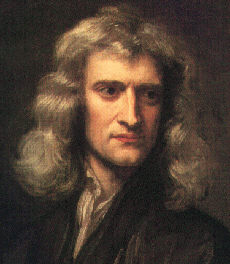
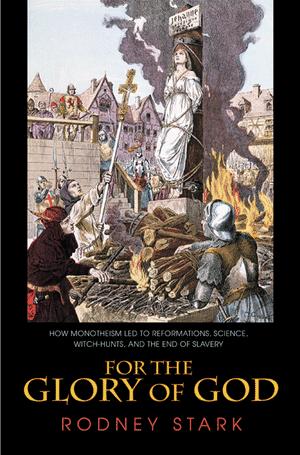
Rodney Stark, now a professor at Baylor, argues in The Glory of God that Isaac Newton (1643-1727) , along with Galileo probably the most influential originator of the Scientific Revolution, was an empiricist who believed that his scientific experiments confirmed the existence of a Biblical God.

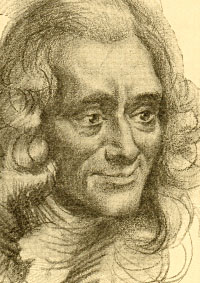
Voltaire (1694-1778), living in exile in England from 1726 to 1729, never met Newton, but befriended his heir and niece, Catherine Conduitt. From her he learned of, and later popularized, the apocryphal story of Newton developing the theory of gravity while sitting under an apple tree. An apple falling from the tree, it was said, prompted his thinking on the matter.

Voltaire popularized and championed Newton's empirical scientific approach, but supplanted Newton's Christian faith with his own Anti-Christian Deism. And it is that intellectual legacy that began the perceived split between faith and scientific reason.

Voltaire's own committment to the discovery of truth through the application of reason, of course, is highly suspect, given his virulent anti-Semitism and clear racism towards the black race. A wealthy man through speculations on the French state lottery, Voltaire increased his wealth by investing in the infamous Compagnie des Indes, the government approved slave trading monopoly that transported over 1 million Africans to the French colonies during the 18th century.

Another example of how Sam Harris' vaunted "secular rationality" easily transforms itself into the deification of the rationalist's personal concepts.

Tuesday, February 06, 2007

Random musings of a writer facing his deadline

It is an odd sort of masochism, this writing hobby. Note that I use the word "hobby" rather than "business." Though I generally don't agree with all of Dave Ramsey's pronouncements, I do agree with the definitional distinctions he makes between a hobby and a business. A business makes money. A hobby takes money. So far, writing is a hobby that is about to become even "hobbier".

My friend Keith Raffel, for whom writing has progressed from a hobby to a part time business, provided a gentle nudge for another posting. It is good to see that someone is actually reading this blog, though by my page views it would appear that there are far more readers than commenters.

(picture of David Hume at right) As to the writing, I have been struggling to find the intellectual underpinnings of John Calhoun's "slavery as a a positive good" speech in 1837, and am pleased to report that I have indeed found it, and in exactly the camp I thought it would be. Remember, I am countering Sam Harris' contention that "the most committed" Christians were responsible for creating and sustaining slavery. As to the origin of the African slave trade, it is clearly to be found in the pure greed of Portuguese, Spanish, and English traders. As to its defense once established, I have found the "smoking gun", if you will. Calhoun's position was a logical extension of the "rational" and "moral objectivist" philosophy articulated by the icon of the Enlightenment in Scotland, the philosopher David Hume. For the full argument, you'll have to read Letter to an Atheist, but suffice it to say that Mr. Hume's racism was exposed in his 1740 work Treatise on Human Nature.

So the intellectual torch on this issue passes from David Hume to James Tobin to Thomas Dew to John C. Calhoun, each writer becoming progressively more exultant on the superiority of the white race to the black, with Calhoun firmly pronouncing by 1837 that social organization would best be served indefinitely into the future with white masters and black slaves.

Set two tables for dinner. At one place Hume, Tobin, Dew, and Calhoun. At the other place the politically engaged Christians who worked on both sides of the Atlantic to end slavery -- Thomas Clarkson, William Wilberforce, John Fee, Thomas Jefferson Randolph. With whom would my nemesis Mr. Harris find commonality ?

That's right ! The defenders of slavery.

Isn't research wonderful ?

Saturday, January 27, 2007

A tight timeline for Letter to an Atheist

Regular readers of this blog are aware of the mid course correction my writing has taken. Fort Desperate remains in hiatus, awaiting the final edit, while I focus furiously and exclusively on finishing Letter to an Atheist by February 10.

It will end up being about 150 pages, and the first complete draft is done. The problem with a polemic is to write with an engagingly clever and zingy style. My nemesis, Mr. Harris, has accomplished such a style, so the standard for writing style is quite high.

Readers will pleased to know that my appendix listing of 25 factual errors in Letter to a Christian Nation is complete, and quite zingy.

We've selected a book cover style, got the printer (Print-on-Demand) lined up and ready to go on receipt of the PDF files.

I'll be relying on the members of the Williamson County Public Library Writers Group for last minute editing help, but I feel pretty confident we'll make the February 10 deadline.

Book blurbs present a bit of a timing problem. I'm looking for just three good blurbs, but don't know if I'll have enough time to get the galleys out for review, with time for comments before the final publication. We might see a back jacket with no blurbs. Can you say second edition ?

Working backwards to the March 4 joint book signing with Christine Schaub at Landmark Booksellers in Franklin, I'll need to send out a couple hundred post cards around February 18th, which means they need to be ordered around the 10th. We're also looking at email blasts late February, and Christine's publicist will take the lead on press releases.

Walden Media sent the DVDs of the movie Amazing Grace and some additional materials, and Christine and I have our first "dry run" of our book signing presentation scheduled with a small group of a church on February 9.

One issue remains to be decided, and that's the name we give the book signing event. I had original considered "The Role of Christian Faith in the Abolition of Slavery", but that sounds a little too stuffily historical. And, abolition is really just an example of the role of Christian faith in the political process.

So, dear blog reader, if you have any ideas as to what we should call the book signing event, please leave a comment here with your thoughts.

Thursday, January 25, 2007

Is God Working Through a Lesbian Canadian Muslim ?

No that question is not the punchline to a bad joke.

Irshad Manji, a Muslim woman who was born in Uganda and emigrated at the age of four to Canada with her family, has written an extraordinarily hopeful book, The Trouble with Islam. Published in 2005, the book argues that the Muslim world's fanaticism stems directly from an overly literal reading of the Koran. Manji advocates the revival of an early Muslim tradition -- the ijtihad, a process in which theological answers are determined by Muslims using other Islamic works as well as a process of dialogue and inquiry.

Her goal is to establish a worldwide network of moderate Muslims who reject the violent fanaticism of jihad.

A very encouraging start that suggests a couple of thoughts.

First, notice the eerie parallel between the difficulties caused in 19th Century America on the topic of slavery by an adherence to a rigidly literalistic interpretion of the Bible.

Second, consider the extraordinarily poor job we in the West have been doing to aggressively advocate and support the growth of the type of moderate Islam championed by Ms. Manji.

Lest I overestimate the optimism one can associate with Ms. Manji and her philosophy, consider her very "feel good liberal" suggestions made earlier this month on 3 ways to improve the world.

1. If this hellish war [in Iraq] is all about democracy, why not hold a simultaneous referendum in America and Iraq about what to do? Politicians from each country would go to the other country to make their case to the people. American politicians would have to get out of the green zone -- which the Iraq Study Group barely did -- and Iraqi politicians would have to stump in those states where the loss of U.S. soldiers has been highest.

Imagine an established democracy and an emerging democracy working together to resolve a conflict of global proportions. If nothing else comes out of this cross-cultural referendum, the people of each nation would learn something about each other. Like "Wow, they're just as confused as we are." Empathy can only be a good thing.

2. Which brings me to another nagging problem -- American power. I'm not one of those resentful Canadians who screams that the United States lies at the root of all evil. (Sorry to disappoint.) But as a global citizen who's affected by Washington's decisions, I have the right to propose this idea: The American constitution should be amended so that any president who declares war must commit a family member to the front lines.

Consider the pressure this would put on the president at the next family gathering, when the relatives interrogate him or her about why their own flesh and blood is on the firing line. The price of launching a premature war is that you could become an outcast in your household. That's sure to make the commander- in-chief think twice (or, in the case of pure ideologues, think once).

3. None of this is to let Europe off the hook. The European Union can be an honest broker between the U.S. and Iran to defuse the nuclear issue. The key is to engage Iraq's top Shia cleric, Grand Ayatollah Ali al-Sistani. Here's the idea: Europeans should quietly lobby al-Sistani to issue a fatwa (legal opinion) against Iran's efforts to go nuclear.


All three of these suggestions are relatively naive non-starters, but, on balance, I can do nothing but cheer Ms. Manji on in her efforts to create a worldwide network of moderate Muslims.

Wednesday, January 24, 2007

Transforming a "necessary evil" to a "positive good"

Digging more deeply into research on the origins of the "slavery as a positive good" argument first articulated on the national scene by John Calhoun in a speech to the United States Senate in 1837, I'm finding a fascinating story. (photo of Calhoun on the right)

Calhoun was a moral objectivist, United States Senator, and plantation owner from South Carolina, and though the most well known and first national politician to set forward the thesis, he was not the first.

Sam Harris would have us believe that the argument originated with Southern clergymen, who were simply reading the Bible as it is written.

But the originator of the argument was not a Christian clergyman, but another moral objectivist, Thomas R. Dew (1802-1846), a political economist and President of William and Mary College who published in 1832 a glowing utilitarian defense of slavery in his Review of Debates in the Virginia Legislature.

The first Christian clergyman to advance the argument was James Smylie of Mississippi, who published his Response to the Chillicothe Congregation in 1836. As historian Lawrence Tise pointed out, Smylie, along with the other early clergymen who advanced the "slavery as a positive good argument" were all slaveholders themselves. Smylie owned 53 slaves, and was the third largest slaveholder in Amite County, Mississippi.

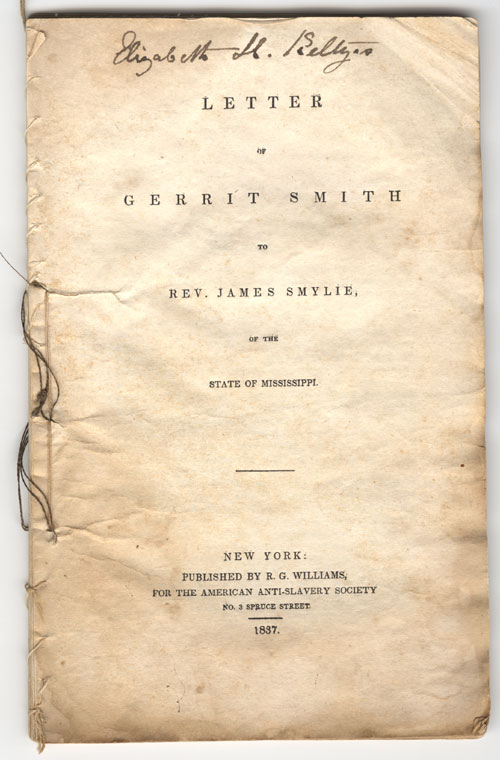
The abolitionist Gerrit Smith responded to Smylie with his own defense of the abolitionist position in 1837. Smith lived in Peterboro, New York, a small village in central New York, near Munnsville, another small village in which I lived as a young boy. I remember learning of Smith at the time, reading a few road side signs about him , and being disappointed that his role was that of an intellectual and not a general. Now, I wish I had learned more about him !

Tuesday, January 23, 2007

The curious case of James Henley Thornwell

James Henley Thornwell (1812-1862) was a Presbyterian clergyman from South Carolina who was one of the most articulate defenders of the "Bible sanctions slavery" argument during the three decades preceeding the American Civil War. Unlike John C.Calhoun, who argued that "slavery is a positive good" purely on grounds of social utility (and without a single reference to the Bible), Thornwell advanced a more subtle argument.

While "man-stealing" and the African slave trade were prohibited by the Bible, the institution of slavery itself, he argued, was not prohibited. Christian masters, however, had certain obligations which they must fulfill towards their slaves. Slaves owed their labor to their masters, but nothing more. Thornwell promoted literacy, knowledge of the Bible, establishment of the institution of marriage within slavery, and respect for the slave family.

First heard on the public stage in the 1840's, Thornwell had, by 1860, significantly modified his views. Though pointing to a long list of Bible passages he claimed supported slavery, Thornwell acknoweldged that the institution itself was clearly not within the spirit of the Gospel. Discouraged that masters would be able to consistently fulfill their Christian duties towards slaves, and mindful of the likelihood of terrible war about to break out around the topic, Thornwell was about to unveil his own proposal for the gradual emancipation of all slaves when his fellow South Carolinians fired on Fort Sumter.

Once the issue was joined, however, Thornwell threw his lot in completely with the Confederacy.

History is filled with "what ifs" and "if onlys". The student of history today can only wonder how events would have unfolded had Thornwell come to his epiphany as little as a year before 1860.

Wednesday, January 17, 2007

Mike Cope reviews Letter to a Christian Nation

Mike Cope, the wonderful preacher at Highland Church of Christ in Abilene, Texas, offers a surprisingly gentle review of Sam Harris' Letter to a Christian Nation.

When [Sam Harris] says that “atheism is not a philosophy . . . it is simply an admission of the obvious,” I think he’s self-deceived. Isn’t that like an overly-confident declaration of being opposed to over-confidence? And when he’s utterly amazed that “80 percent of Katrina’s survivors claim that the event has only strengthened their faith in God,” perhaps he should ask if there is more going on in this world than a scientist can test and a rationalist can figure out.

Why does faith flourish in pediatric oncology wings of hospitals? (It’s the question that led Dr. Diane Komp, a pediatric oncologist, back to faith.)

But having said that, I think Harris has done us a favor by writing honestly and clearly about what faith looks like from his perspective. He has pointed out some things that we must face if we’re going to have a voice in this world. I’d love to be in a study group with a bunch of university students working through this. I trust that our faith is not too fragile to face such arguments with compassion and truth.


For his complete blog posting on the topic, check out his blog at Preacher Mike.

I am surprised that Mike attributes honesty to Harris' argument. I've already documented 25 instances of intellectual dishonesty in Harris' slim 91 page volume (starting off with completely misrepresenting a Gallup Poll on creationism and evolution, continuing to knowingly misquoting Christian evangelicals, and ending up with falsely portraying study data that he should know is flawed).

I don't disagree with Mike that we should be ready to take atheism's best shot at our Christian beliefs, but if Harris' argument is the best shot that philosophy can offer, none of us need worry that any clear and honest thinker will have his faith shaken !

Friday, January 12, 2007

Joint Book Signing March 4 at Landmark Booksellers

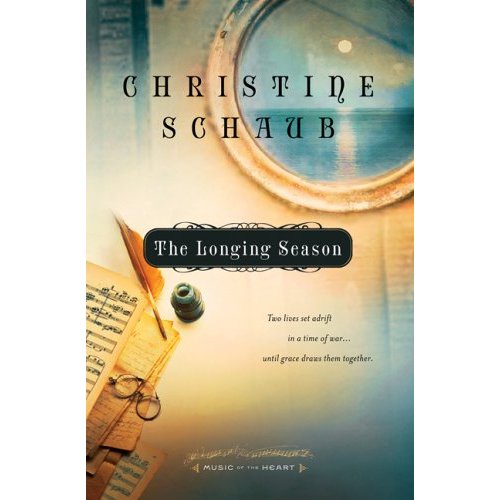
Christine Schaub, author of The Longing Season, and I will hold a joint book signing at Landmark Booksellers in Franklin, Tennessee on Sunday, March 4 from 3 pm to 5 pm. The event will include our joint presentation on The Role of Christian Faith in the Abolition of Slavery, as well as selected film clips from the soon to be released movie Amazing Grace.

I will be signing copies of my first book, Letter to an Atheist, scheduled for publication by Harpeth River Press on February 23, 2007, the same day Amazing Grace the movie premieres.

I devote an entire chapter of my book to debunking the false claim that Christian Faith, acting in complete concert with the Bible, created and sustained slavery in America. Contrary to the argument made by Sam Harris in Letter to a Christian Nation, a two fold failure of the Evangelical Christian movement in America contributed to the Civil War as the ultimate arbiter of the slavery question.

First, both traditional and Evangelical Christians in the South were inordinately influenced by the "slavery is a positive good" argument developed by moral objectivists such as John Calhoun, William Yancey, and Edmund Ruffin, and constructed contrived arguments from Old Testament passages to falsely claim that the Bible not only tolerated slavery, but in fact sanctioned it.

Second, Evangelical Christians who knew that the golden rule -- "love thy neighbor as thyself" -- could only mean that the Bible and Jesus Christ condemned slavery -- Methodists who followed John Wesley and Stone-Campbell movement revivalists -- either kept quiet in their Southern homes, moved North, or like John Fee of Kentucky, suffered terrible ostracism and persecution from their neighbors.

Where Evangelical Christians in Britain waged a successful political fight to end slavery, Evangelical Christians in America either failed to wage that fight effectively, or were co-opted in their theology by moral objectivists.

Ms. Schaub and I have put together quite an interesting presentation, that should run about an hour or so, and we welcome the opportunity to speak to your small group prior to the book signing for a practice trial run. If you would like to "book" this preview presentation, please email me at mike@michaelpatrickleahy.com.

Wednesday, January 10, 2007

Christine Schaub reviews "Amazing Grace"

Here's novelist Christine Schaub's review of Amazing Grace, the movie:

The movie does a good job explaining that the commerce of slave trading was not a moral issue to the majority of Britons. The filmmakers’ greatest error is having the movie’s central figure—William Wilberforce—introduce his impromptu singing of “Amazing Grace” with an attribute to “…my old preacher-friend who was a slave ship captain for twenty years…” Not true—but it flashes by so quickly, most viewers won’t catch it.

I like to tell readers The Longing Season is a good primer to the film version of “Amazing Grace.” My book introduces the conflicted young man who becomes one of many powerful voices for humanity decades later. The subjects of slavery and redemption are still weighty and poignant today, and there’s nothing like a good read and an afternoon in a darkened theatre to explore one’s mind and soul.


Click here to see Christine's full review.

Thursday, January 04, 2007

Darnell Arnoult is Fabulous

Tennessee writer Darnell Arnoult, whose debut novel Sufficient Grace has received rave reviews spoke to the Williamson County Public Library Writers Group this evening.

A group of 14 local writers sat enthralled by the very Southern, very gracious Miss Arnoult, who left us with more than a bakers' dozen of excellent ideas to improve our writing.


Miss Arnoult describes the process of writing in lyrical but practical ways that inspire the listener to look at his or her work systematically but still artistically.

I hear tell that the Williamson County Public Library may be bringing Miss Arnoult back again soon to conduct a Writer's Workshop. My advice: Walk don't run to sign up when it's announced !

Wednesday, December 27, 2006

A Cat Fight in Key West

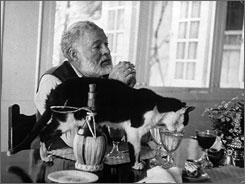
In the category of bizarre stories comes this one in USA Today from Key West, Florida. Turns out the Hemingway Museum there has about 50 cats, many of them descendants of the six toed Snowball, who lived at the residence with Hemingway and his family during the 1930's. One of the museum's neighbors has complained to the US Department of Agriculture that the museum is not keeping these cats out of trouble. So, in an excellent use our our federal tax dollars, the USDA has launched a federal investigation of the museum. Gum shoed investigators have rented rooms in an adjacent motel, and spend their days videotaping the movement of these 50 cats. Turns out that -- horrors of horrors -- one of the cats scaled the museum wall and went out into the street.

Another sign of the decline of Western Civilization. When simple disputes require a federal investigation to resolve we must be losing our collective common sense, wouldn't you say ?

I'm not sure what this says about me or about Hemingway's writing, but I haven't been able to make it through one of his books since high school. At 15 I was a Hemingway fiend, reading at least a dozen of his classics. But as an adult, his prose seems contrived and his heroes seem shallow and one dimensional. Does anyone else feel the same way about Hemingway ?

Wednesday, December 20, 2006

William Wilberforce, John Newton, and Amazing Grace

As I finish revising Chapter Two of my latest work-in-progress, Letter to an Atheist, I see signs of 18th Century reformed slave trader John Newton and his younger friend, politician and Christian abolitionist William Wilberforce all around.

Newton, of course, wrote the hymn Amazing Grace, and his younger protege Wilberforce was the Member of Parliament responsible for persuading that body to end the slave trade in 1808 and then abolish slavery throughout the British Empire in 1834. Both men play an important role in my Chapter Two on the Bible, Christianity, and Slavery, in which I refute the contentions of atheist Sam Harris that the Bible unequivically supported slavery and that most Christians prior to the Civil War accepted that view.

Look for the stories of Newton and Wilberforce on the big screen this February when the movie Amazing Grace is relased. Produced by Patricia Heaton (the former co-star of TV's Everybody Loves Raymond), and starring Ioan Gruffund (Horatio Hornblower in the A and E series), it will be interesting to see what kind of box office this film will achieve.

The movie focuses more on Wilberforce's story, as well as that of his friend Equiano, the freed slave from West Africa (see portrait of the historical Equiano and the actor who plays him to the right).

Newton's slave trading, conversion, and hymn writing occur decades earlier, and his story is told in Christine Schaub's new novel, The Longing Season. Newton is an old man who befriends the younger Wilberforce in the movie.

Friday, December 15, 2006

Landmark Booksellers in Franklin, Tennessee

I stopped by Landmark Booksellers, a two year old independent book store just off the square in Franklin, Tennessee, and visited with its owner, Joel Tomlin. A veteran entrepreneur with a knack for real estate, Joel purchased the large historic building at 114 East Main Street at the same time he purchased the entire inventory of 40,000 books owned by Dad's Old Book Store, the Green Hills book store that closed down a couple years ago.

A native Nashvillian, Joel is a lover of books, Southern Literature, and the Civil War. He also brings to mind visions of stylish Confederate Generals of yesteryear. I include here a photo of General Beauregard, whom I think Joel favors (as the term is used in the South).

Joel's strategy is a good one I think. Purchase real estate off the square in a growing but historic Southern town. Fill the book store with rare and old books, but also make new books available. Make the store a friendly place to come and hang out and browse. Give all sorts of groups -- poets, writers, Civil War buffs -- a place to hold regular events. Feature local writers and hold lots of author signings.

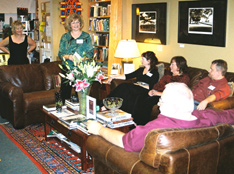
You can see the inside of Landmark Books here, as well as a picture of a local author speaking. That's Kathy Hardy Rhodes, author of Pink Butterbeans. And, in an interesting convergence of worlds (see the preceeding post), Pink Butterbeans is published by Cold Tree Press !

Thursday, December 14, 2006

Peter Hornsberger and Cold Tree Press

I had a terrific phone conversation yesterday with Peter Hornsberger of Cold Tree Press, based here in Nashville. Peter, a native of Vermont, is a veteran graphic design and advertising industry executive who founded a POD (Print-on-Demand) publishing company in his garage five years ago. Now, after publishing about 100 books, he's ready to move into a real office in Brentwood, along with his four employees.

Just by looking at the Cold Tree Press website you can tell this is a quality operation. Here's the business model:

Cold Tree charges authors a one time up front fee of between $900 and $1400 to get their books print ready. Services include formatting the text, designing the book cover, and can include editing (though extensive editing is an extra fee). Once the book is ready, Cold Tree subcontracts the actual production to Lightning Source, the local Ingram Books subsidiary that specializes in digital POD printing. Print runs typically are in the range of 1 to 1000.

The author maintains the rights to the book, but Cold Tree owns the books produced this way. Authors can purchase their own books from Cold Tree at a 40% off retail price. They also receive a 30 per cent royalty on books sold through the Cold Tree website and a 15% royalty on books sold through retailers or online retailers.

The best total sales from a title in the Cold Tree catalog has been 3,000 units.

Cold Tree will be offering an offset print option next year, which means initial runs will be 1,500 minimum.

Sunday, December 10, 2006

Yet another Red River !

Thanks to blog poster Captain Boone for letting me know about yet another book titled Red River. I knew about Lalitha Tademy's upcoming book of that title, but was unfamiliar with P.J. Nagle's 2003 Red River, published by Forge Books.

A brief review of the outline provided me with great relief.

The book is set in the Red River Campaign, but the story is significantly different than mine.

Nagle appears to have blazed the trail to write fiction of lesser known battles of the Civil War west of the Mississippi (hey, that's MY path !) a decade earlier. Fortunately, her trail seems to be much further west than mine, focusing on New Mexico and Galveston, with Red River being her eastern most foray.

This leaves me, of course, with the problem of coming up with a title for the second book of the trilogy. Red River being unavailable, Captain Boone points out that Bailey's Dam may not work well, since Joseph Bailey may not have been a particularly admirable character. In any event, his engineering feat was the single most important event of the campaign.

So, I leave it to you, dear blog reader. Ideas for the title of the second book ?

Saturday, December 09, 2006

Robert Hicks, author of The Widow of the South

I heard Robert Hicks, author of The Widow of the South, speak today at the Williamson County Public Library. He told a great story about his first and only meeting with the legendary Shelby Foote.

Also did a great job describing the context of the Battle of Franklin, and how the battle's outcome sealed the fate of the South.

There were 60 people in attendance. Surprisingly, not a one under 30. A good one third of the audience was over 70. I wish we could get more young people interested in writing in general, and the Civil War in particular.

The great news was the topic for his next book.

The last three days in the life of John Bell Hood.

Now there's a great start !

Friday, December 08, 2006

An Alphabetical Life

Wendy Werris has written a terrific memoir about her life as an independent rep for book publishers. With an engaging title (An Alphabetical Life) the book includes great tales about accompanying authors to their book signings and the writing life.

Love the book cover !

Would love to have Wendy speak to our writers group, but the trek from her home in Los Angeles to Nashville might be a bit of a stretch.

A walking oxymoron

The Williamson County Public Library Writers Group met last night. Every time I go to the library I am impressed and thankful to the architect for the beauty of the building. Thanks to Janice Keck, Executive Director, we are now meeting in the Board Room, which is ever so comfortable. Nice room, nice big leather chairs, very pleasant.

This time, we had six writers in attendance. Four old hands and two newbies. One of the newbies responded to the notice in the local paper the library puts out. Seems like every meeting we get one or two newbies from that source.

This newbie was most interesting. His name is Terry, and I think he may well be a walking oxymoron.

He is an Information Technology professional. He's spent his entire career writing code, and now installing high level software.

Guess what genre he wants to write in ?

Romance novels !

I cannot wait to read his first chapter. Any advice for Terry from romance novelists out there ?

Now, I am really looking forward to hearing his first chapter. Talk about worlds colliding !

Wednesday, December 06, 2006

Some kind of something from the fabulous Ms. Vater

This was posted on the blog of Rachel Vater about six hours ago. She's the fabulous young literary agent who received an e-query from me back on November 10.

I’ve caught up on my e-mail queries from October 28 to November 28. If you sent me one during that time and haven’t gotten a response yet, then you either didn’t use the website form (and it’s possible it got buried in my other inbox) or the e-mail you listed didn’t work and bounced back to me, or your SPAM filter stopped it… or I’m holding on to it. I’ve saved 20 out of over 200 e-mail queries to look at more closely, give a personal reply to, forward to another agent here, or request myself.

Having not received a form e-mail back from Ms. Vater yet, I assume that my query is among those 20 to be looked at more closely, or about to receive a personal reply.

Ms. Vater is from Kentucky, and therefore possibly immune to the "Who cares about the Civil War ?" point of view I have ascribed to east coast literary agents. Or, she just might find my writing fabulous.

We'll see if we hear anything further from her.

I am tempted to just send her another email, along with the link to my wiki, where the entire manuscript of Fort Desperate is posted (password protected, of course). But I think I'll just wait and see what she has to say.

I do take a degree of satisfaction in knowing that I finally appear to have made a bit of progress in the agent search process. Hey, and it's taken far less than five and a half months this time !

Monday, December 04, 2006

Five and a Half Month E-Query Response

On July 14 I sent an e-query to Manus Literary Agency. Half an hour ago (that would be five and a half months for those of you who are counting), I received the following response in my email:

Dear Author,

Thank you very much for giving us the opportunity to read your submission. We appreciate your considering us for representation of your project.

Unfortunately, after careful review, we have decided that we might not be the right agents for your work. However, we hope that you are not disheartened. This industry is incredibly subjective, and there are many agencies out there with many different tastes. We strongly encourage you to keep submitting elsewhere, as you might already have a bestseller in your hands.

We apologize for the form letter reply, but the volume of submissions we receive has finally made it impossible for us to hand-write responses as we have for so many years. We hope you will understand and forgive us this necessary efficiency. In addition, we do not feel it is proper for us to provide editorial feedback on projects we have decided not to represent.

We wish you the very best of luck and success with your work, and urge you to keep on writing!

Sincerely,

Manus & Associates Literary Agency


This is just too rich not to post !

Saturday, December 02, 2006

Better Together ? Not without individual responsibility within a covenantal community

Lew Feldstein, co-author along with Harvard professor Robert Putnam of Better Together, the follow up book to Putnam's Bowling Alone, will be speaking in Franklin, Tennesse this week on the topic of building social capital within communities.

Now, I'm all in favor of this. And, if there is a community in America where social capital has been developed, and has potential for developing even further, it's Franklin, Tennessee.

But there's a certain hollowness to the exclusively secular approach to building social capital that Feldstein and Putnam champion. Discouraged by what he saw as the disintegration of American civic activisim that he cataloged in Bowling Alone, Putnam joined with Feldstein in a tour of the United States to find and write about examples of community based activism that built positive social capital. And they found about a dozen, which they describe in their book. Eight of these examples are listed on their website:

(1) A mentoring and reading program in Philadelphia that brings together retirees and elementary school children to the benefit of both – the children get help reading and the retirees have a richer, more purposeful life
(2) A group of sixth-grade activists in a small Wisconsin town who managed to persuade local authorities to improve safety at a railroad crossing and in doing so learned a valuable lesson in civic activism
(3) A neighborhood in Boston that has been revitalized by a civic association that overcame ethnic differences and now plays an ongoing role in the neighborhood
(4) A community effort in the impoverished Rio Grande Valley, one of the poorest regions in the U.S., that brought such basic services as electricity, roads, and health care to the mostly Spanish-speaking residents

(5) A successful small business initiative in Tupelo, Mississippi, that began sixty years ago with the purchase of a prize bull
(6) Chicago public libraries that have broadened their mission and have become true community centers
(7) Two huge and rapidly growing churches in Los Angeles that are making people feel connected to other church members and their community
(8) The city of Portland, Oregon, where the anti-war movement of the sixties actually changed the institutions so that now there is a remarkably high level of civic engagement in government and politics (more so than in other cities, even other cities on the west coast).


It's interesting to note that the only faith based example Feldstein and Putnam cite is credited for how it connects church members, but not why these church members are connected.

They also suggest 150 ways to build social capital within a community. Only one of those suggestions is faith related, and it's even couched to a degree.

Suggestion 59. Go to church...or temple...or walk outside with your children–talk to them about why its important

I'm left wondering if their point here is to simply engage in some activity with your children.

There's a problem with the secular approach to building social capital. Sooner or later, the charismatic leaders of the particular community program will die or leave, and the remaining infrastructure may not be strong enough to sustain the effort.

I think a better, more long lasting model of buidling social capital within communities is what I call individual responsibility within a covenantal community.

What do I mean by a covenantal community ?

I mean a community which is anchored by a group of believing Christians who belong to one or more of the following institutions:

A church
A classical Christian school

There are many mutually re-enforcing covenants within a covenental community. All of these covenants are an extension of the single most important covenant--

The covenant between God and Man.


The subordinate coventants of which I speak are those between:

Husband and wife
Fellow believers
Parents and children
Pastor and church members
Teachers and students

Dear Author . . .

Miriam Altshuler, literary agent, followed Janet Reid's example with a negative response to my snail mail query. Unlike Miss Reid ( Miss Snark ?), Ms. Altshuler sent a form letter (well really a form snippet of paper 8 inches by 3 inches) that began

Dear Author:

Nope !


It's been a month, and still no response from my e-query to Rachel Vater. I am beginning to think that east coast thirty something women may not care about the Civil War. Or, to be specific, my novel about the Civil War. At least Miss Reid took the time to hand write her rejection.

So, I am wondering if this querying of New York based agents is just a waste of time. Of course, it could be that they like the Civil War, just don't like my writing about it !

Jeff Shaara is his own agent. I am not sure who represents Howard Bahr, but I am going to check out who does. I know that Robert Hicks, author of The Widow of the South, was represented by Jeff Kleinfelder. He's out of Washington D.C., and definitely not a thirty something woman, though he is an east coaster.

This is a theory mind you, so if there are any east coast thirty something women out there who are reading this, try answering this question for me -- Do you care about the Civil War ? Or are you totally disinterested ?